


The Köthen Bach Collective
The BachCollektiv was founded during the 2016 Köthen Bach Festival Days: under the artistic direction of violinist Midori Seiler, 18 musicians from 12 nations gathered in Köthen for seven days to work together and follow in Bach’s footsteps. Since then, this resident ensemble—comprising prize-winners from international competitions, professors from renowned music conservatories, internationally acclaimed soloists, and outstanding students—has established itself as a cross-generational musical team of exceptional quality. You can find further information about the Köthen BachCollektiv at www.koethenerbachcollektiv.de!
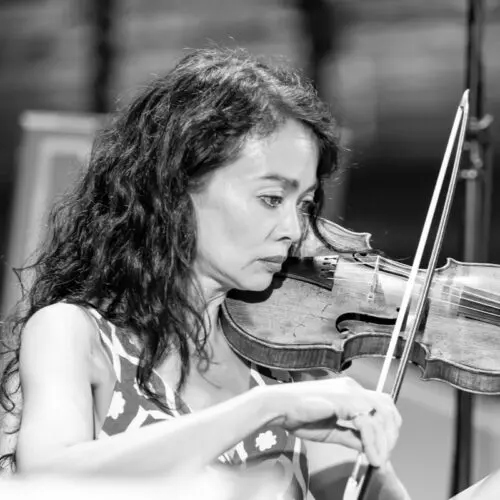
Midori Seiler
Violin and Conductor
Midori Seiler is one of the few specialists in historically informed performance who feels at home across various musical eras. As a concertmaster, she has led a wide range of projects with ensembles such as the Budapest Festival Orchestra, Anima Eterna Brugge, and the Kammerphilharmonie Bremen. Her chamber music partners include Christian Rieger, Jaap ter Linden, and Andreas Staier. In 2015, she was awarded the Saxon Mozart Prize. Her extensive discography includes violin concertos by Mozart, Rimsky-Korsakov’s *Scheherazade*, and her own reconstruction of Bach’s lost violin concerto (BWV 1052). Recordings of the complete violin and piano sonatas by Mozart, Beethoven, and Schubert bear witness to her long-standing collaboration with Jos van Immerseel. Her two releases of Bach’s solo works garnered significant media attention. After serving as a professor of baroque violin at the music conservatories in Weimar and Salzburg, she began teaching at the Folkwang University of the Arts in Essen in 2020. Since 2016, Midori Seiler has served as the artistic director of the BachCollektiv at the Köthen Bach Festival. Her adventurous approach to concert formats has led to collaborations involving contemporary dance, electronic music, and choreographed performance; for instance, she developed a production of Bach’s sonatas for solo violin featuring two dancers, choreographed by Juan Kruz de Garaio Esnaola. Her album *La Venezia di Anna Maria*, recorded with Concerto Köln, won an OPUS Klassik award in 2019.
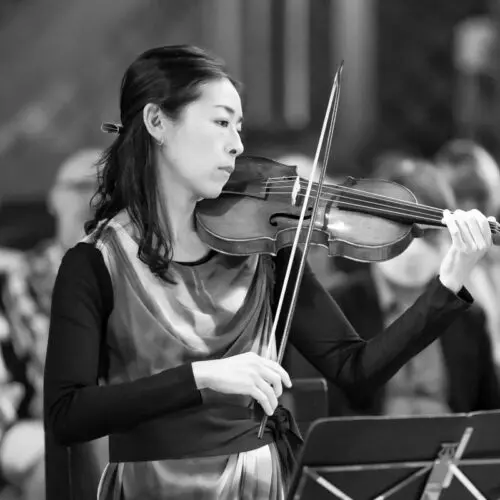
Mayumi Hirasaki
Violin and Conductor
Mayumi Hirasaki began her violin studies in her native country at the Tokyo National University of Fine Arts and Music. In 2001, she moved to Germany to study under Daniel Gaede at the Nuremberg-Augsburg University of Music, where she earned both her diploma with distinction and her master class diploma. While still a student, she was appointed to a teaching position at the same institution. Passionate about early music, she studied baroque violin with Mary Utiger at the University of Music and Performing Arts Munich, followed by studies with Giuliano Carmignola at the Lucerne School of Music. She also completed the “C-level” church musician certification in the Archdiocese of Bamberg and subsequently majored in harpsichord under Christine Schornsheim in Munich. Mayumi Hirasaki has won prizes at numerous competitions in Japan and Europe, including the International Bach Competition in Leipzig and the Early Music Competition in Bruges. Since 2011, she has served as concertmaster of Concerto Köln, collaborating with conductors and soloists such as Peter Dijkstra, Andrea Marcon, Pablo Heras-Casado, Hans-Christoph Rademann, Giuliano Carmignola, Dorothee Oberlinger, Midori Seiler, Simone Kermes, Vivica Genaux, and Valer Sabadus. She is also a regular guest performer with various baroque orchestras and ensembles—such as the Akademie für Alte Musik Berlin, Dresdner Festspielorchester, Zurich Chamber Orchestra, Basel Chamber Orchestra, Gaechinger Cantorey Stuttgart, The King’s Consort, Neue Düsseldorfer Hofmusik, Collegium Cartusianum, La Divina Armonia, Il Suonar Parlante, and Il Gardellino—appearing in concerts across Europe, the USA, and Japan. Her chamber music partners include artists such as Christine Schornsheim, Lorenzo and Vittorio Ghielmi, Francis Jacob, Naoki Kitaya, Marcel Ponseele, Maurice Steger, and Jan de Winne. Her numerous CD recordings include, among others, works by Johann Sebastian Bach (*Bach in Romantic Style* with Christine Schornsheim, a double concerto with Giuliano Carmignola & Concerto Köln, and the Brandenburg Concertos with Concerto Köln), Antonio Vivaldi (*Barbarian Beauty* with Vittorio Ghielmi & Il Suonar Parlante), and Charles Avison (*Concerti grossi after Scarlatti* with Concerto Köln).
Between 2009 and 2018, Mayumi Hirasaki held a teaching position for Baroque violin and viola at the Folkwang University of the Arts in Essen. Since October 2017, she has held a professorship for Baroque violin and viola at the Mozarteum University Salzburg.
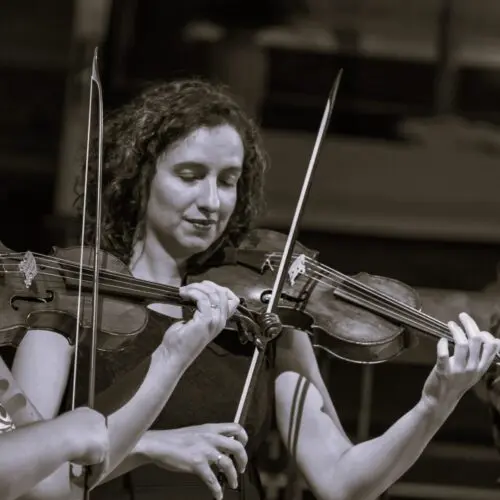
Waleska Sieczkowska
Violin
Waleska Sieczkowska is originally from Florianópolis, Brazil, and now lives in Bavaria, where she maintains an active concert career with ensembles such as the Hofkapelle München, Il Pomo d’Oro (Italy), and Ensemble Turicum (Switzerland). She teaches violin at the music schools in Mindelheim and Penzberg. Her studies took her to the Mozarteum University Salzburg, as well as to Milan and Munich. Together with Anderson Fiorelli, she founded the Villa Duo, which regularly performs throughout Europe and Brazil. She has participated in several recordings for radio, television, and CD.
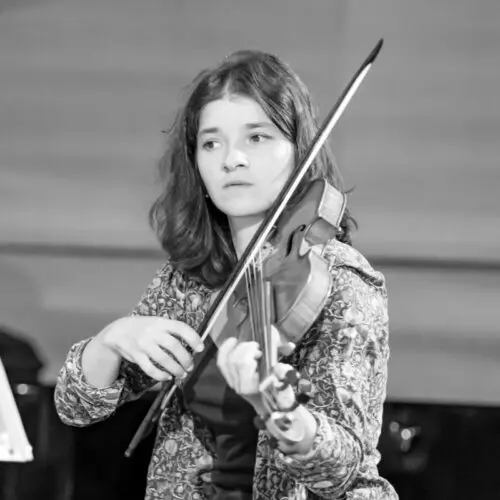
Elisabeth Sordia
Violin
As a child, Elisabeth developed a passion for dance and music and received her initial musical training in Paris. Discovering historically informed performance practice played a pivotal role in her career development. Alongside her viola studies in Cologne and Brussels, she deepened her engagement with early musical idioms and performance styles—including at the Abbaye aux Dames in Saintes and under the guidance of Midori Seiler in Weimar. She gained further experience as an intern with the Orchestra of the Age of Enlightenment and the Orchestre Révolutionnaire et Romantique in London. Today, Elisabeth lives in Paris and performs as a guest musician with various European ensembles, such as Ensemble Pygmalion, B’Rock, Le Cercle de l’Harmonie, and the Freiburg Baroque Orchestra. She is also a member of the BachCollektiv Köthen and a regular guest artist with the Spira Mirabilis collective. Alongside her work as an orchestral musician, she is training in music therapy.
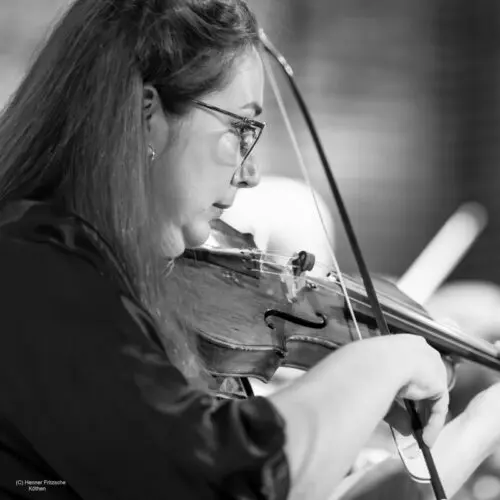
Cécile Dorchêne
Violin
Cécile Dorchêne began her violin studies at the age of 16 at the Paris Conservatory, where she studied under Roland Daugareil. In 2005, she continued her training with Viktor Tretyakov at the University of Music and Dance Cologne. She subsequently studied baroque violin with Petra Müllejans in Frankfurt, completing her studies successfully in 2014. Since 2013, Cécile Dorchêne has served as artistic director of *l’Autre mOnde*—an ensemble dedicated to early and contemporary music—alongside Delphine Roche. Over the past few years, she has performed with internationally renowned orchestras such as the Orchestra of the Age of Enlightenment, The Wallfish Band, the Freiburg Baroque Orchestra, La Stagione Frankfurt, Le Concert Lorrain, and the Geneva Camerata. In May 2014, she appeared as a soloist with the Schwetzingen Hofmusik Academy as part of the SWR Festival. Cécile Dorchêne views music as a sonic language in which emotion, vitality, and spontaneity are the essential means of expression. She particularly values the exciting challenge of collaborating with other artists—and their respective ideas and concepts—to create a new, cohesive, and inspired musical whole.
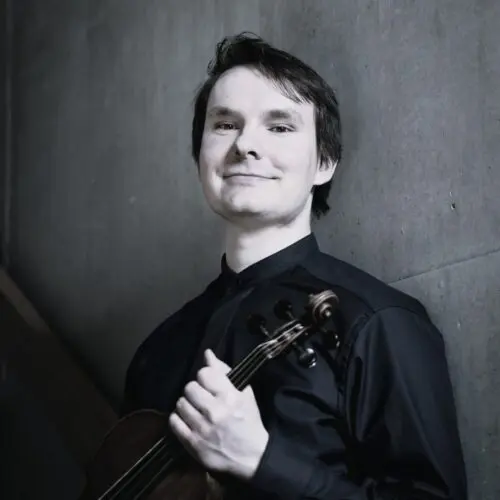
Martin Schneider
Violin
Martin Schneider has been playing the violin since the age of six and later also studied piano and music theory. From an early age, he developed an interest in early music, which led him to join the Bavarian Youth Baroque Orchestra in 2016, where he has been a member and concertmaster ever since.
From 2017 to 2024, Martin studied baroque violin with Prof. Mayumi Hirasaki, and from 2021 to 2025 he studied historically informed performance practice with Prof. Reinhard Goebel at the Mozarteum University Salzburg.
As a baroque violinist and violist, he performs, among others, with the Freiburg Baroque Orchestra, the Gaechinger Cantorey, and the Yara Ensemble. With the latter, he has received several awards, including the special prize “Music and Space” at the göttingen händel competition 2025 and the Baroque Music Prize at the 7th Vienna International Music Competition.
In addition, Martin performs as a soloist with various orchestras in southern Germany.
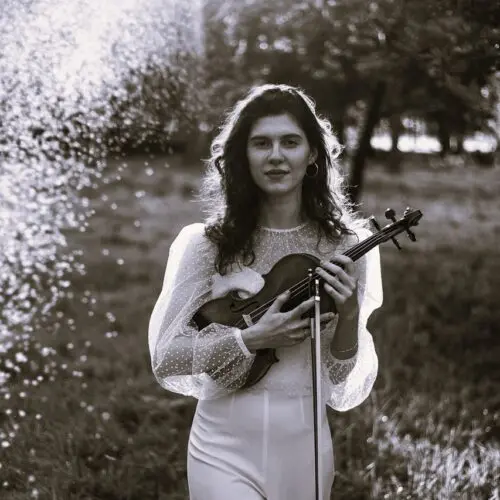
Ekaterina Perlina
Violin
Ekaterina Perlina received her first violin lessons at the age of five in Minsk and made her debut as a soloist with orchestra at the age of eight. She studied with Dora Schwarzberg, Yair Kless, Marc Danel, Andreas Reiner, and others.
She completed her bachelor’s degree with Boris Garlitsky at the Folkwang University of the Arts in Essen; since 2023, she has been studying there for a master’s degree in baroque violin with Midori Seiler and violin with Marc Bouchkov. As a soloist and chamber musician, she has performed throughout Europe, the United Kingdom, Qatar, and the United Arab Emirates.
She was a scholarship recipient of Villa Musica Rheinland-Pfalz and participated in a CD recording of string quartets by Boris Yoffe. As a baroque violinist, she took part in the ZAMUS Academy in Cologne, studying with Kristin von der Goltz and Clara Blessing, and in 2025 she won the Köhler-Osbahr Competition in the Early Music category.
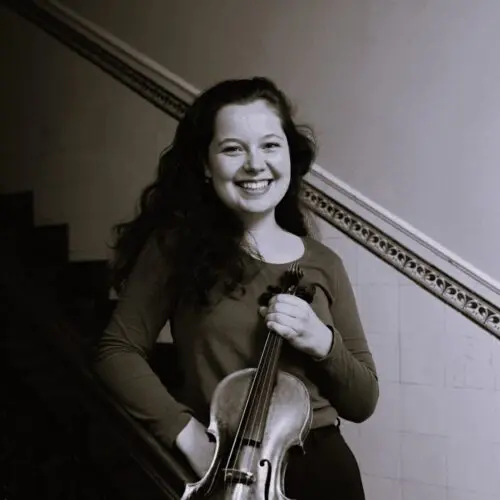
Iris Kengen
Violin
Iris Kengen is a Dutch baroque violinist. While studying modern violin, she met Shunske Sato as part of a project with the Netherlands Bach Society, fell in love with the baroque violin, and began her studies in early music with him.
She studied in Amsterdam with all four baroque violin teachers: Shunske Sato, Sayuri Yamagata, Emmanuel Resche-Caserta, and Antoinette Lohmann. Alongside her studies, she performed as a Young Fellow with the orchestra of the Netherlands Bach Society. She also spent six months as an exchange student in Lyon, studying with Odile Edouard.
She is currently a member of the European Union Baroque Orchestra, with which she is touring Europe this summer. After the summer, she will continue her studies at the Berlin University of the Arts (UdK) with Mayumi Hirasaki.
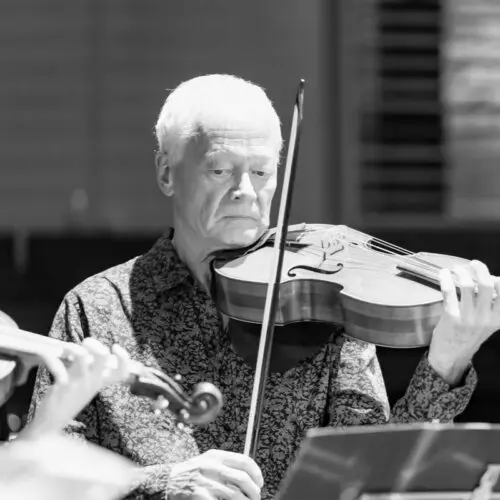
Christian Goosses
Viola
Christian Goosses studied viola at the Freiburg University of Music under Ulrich Koch. He soon developed a keen interest in “historically informed performance.” He connected with the early music scene and played in Nikolaus Harnoncourt’s Concentus Musicus Wien and Reinhard Goebel’s Musica Antiqua Köln. In Freiburg, he was one of the founding members of the Freiburg Baroque Orchestra, with which he toured Europe, the Americas, and Southeast Asia.
He considers passing on his experience to young musicians a vital task; through his chamber music and viola masterclasses, as well as his teaching role at the Folkwang University of the Arts, he offers them inspiration and the opportunity for exchange.
Chamber music remains Christian Goosses’ musical home; it has profoundly shaped his identity as an artist.
For many years, he has been a member of the Schuppanzigh Quartet, an ensemble with which he has been actively involved in recording works by Ferdinand Ries, Ludwig van Beethoven, and Joseph Haydn.
He has recorded Haydn’s sonatas for violin and viola with Anton Steck (Accent) and duos by Michael Haydn, Franz Alexander Pössinger, Franz Anton Hoffmeister, W.A. Mozart, and Ignace Pleyel with Katja Grüttner (musicaphone).
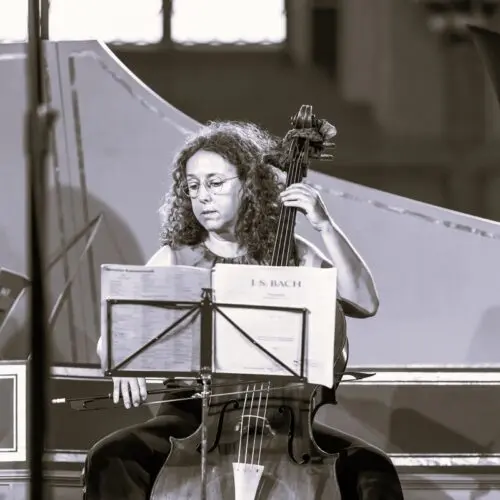
Mercedes Ruiz
Violoncello
Spanish-born cellist Mercedes Ruiz studied in Germany with Michael Kasper and in Belgium with Roel Dieltiens. She rounded out her training with masterclasses given by Christophe Coin, Anner Bylsma, the Melos Quartet, and the Alban Berg Quartet. Since 1988, she has performed with ensembles such as Concerto Köln, Akademie für Alte Musik Berlin, Freiburger Barockorchester, Orquesta Barroca de Sevilla, Al Ayre Español, Le Concert des Nations, El Concierto Español, La Real Cámara, Capella Coloniensis, and Das Neue Orchester, under the direction of conductors including René Jacobs, Philippe Herreweghe, Jordi Savall, Enrico Onofri, Christophe Coin, Monica Huggett, Gustav Leonhardt, Ivor Bolton, Hervé Niquet, and Christophe Rousset. Mercedes Ruiz is also highly active as a chamber musician, performing with groups such as The Bouts Ensemble (New York), La Tempestad, Vie sul Mare, La Hispaniola, and Trio 1790. She has taught baroque cello in Girona (Spain) and is frequently invited to lead orchestral workshops for various youth orchestras in Spain.
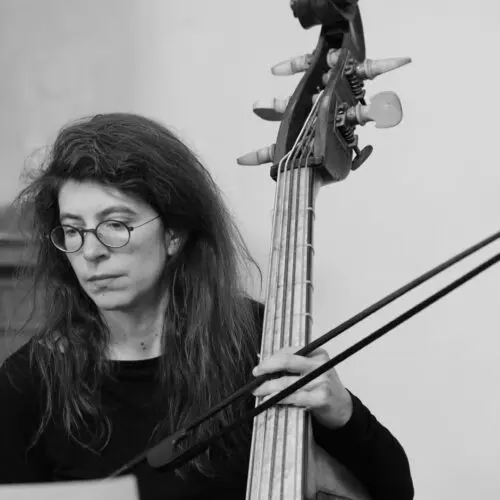
Sophia Scheifler
bass
Sophia Scheifler discovered her passion for the double bass at the age of 18. She initially studied piano in Dresden and subsequently classical double bass in Leipzig, Cologne/Aachen, and Karlsruhe. This was followed by internships and academy positions at Theater Aachen and SWR Freiburg/Baden-Baden.
During her studies, her adventurous and experimental-minded professor, Detmar Kurig, introduced her to gut strings. She was so fascinated by their sound quality that she went on to study historical double bass, bass gamba, and G violone in Trossingen. From that point onward, she found her musical home in historically informed performance practice.
As a member of the La Folia Baroque Orchestra and the ensemble Il Giratempo, as well as a regular guest with the Gaechinger Cantorey Stuttgart, she has since devoted herself particularly to continuo playing. She performs at international festivals including the Utrecht Early Music Festival, the Bustan Festival in Beirut, the Innsbruck Festival of Early Music, the Days of Early Music in Regensburg, the International Baroque Festival Malta, and the Leipzig Bach Festival.
She has also participated in numerous radio and CD productions alongside artists such as Anna Prohaska, Hille Perl, Dorothee Mields, and Giuliano Carmignola. The CD Cleopatra, recorded with her ensemble La Folia and soprano Regula Mühlemann, received the Opus Klassik award in September 2018.
As a freelance bassist, Sophia Scheifler continues to work as a substitute musician with modern orchestras, including the Stuttgart Chamber Orchestra, the Southwest German Chamber Orchestra, and the Reutlingen Philharmonic.
Alongside her concert career, she is a passionate double bass teacher. She teaches at a music school in Stuttgart and shares her pedagogical experience as a lecturer in methodology at the music universities in Trossingen and Stuttgart.
As a versatile artist, Sophia Scheifler repeatedly ventures beyond the traditional classical concert setting. She takes her double bass into improvised encounters at the intersection of music, literature, and dance. She has an intensive artistic collaboration with the writer Anja Kampmann. Together, they have appeared at numerous literature festivals, including the Satellite Poetry Festival in Cologne, the Poetry Gathering in Münster, and the Ensemblia Music Festival in Mönchengladbach. In 2023, they jointly produced a “Christmas Fairy Tale” for the Lesezeit program of Deutschlandfunk.
As part of the THEATERNATUR Festival in the Harz region, she and her bass were involved in the interdisciplinary theatre and dance performance MOMENT.UM. She also developed the music for the RBB radio feature Bring Them Home Now.
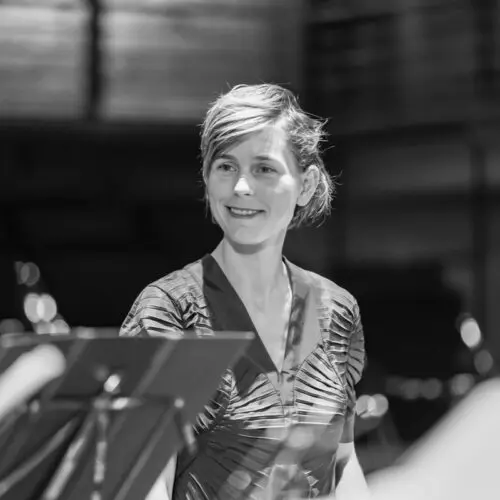
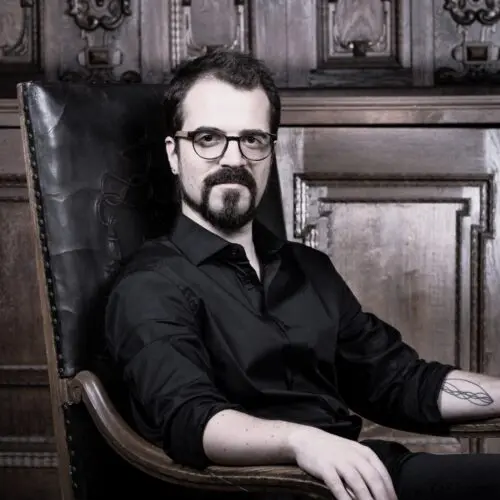
Flóra Fábri
harpsichord
Flóra FábriShe studied harpsichord, historical keyboard instruments, and basso continuo in Budapest with Anikó Soltész, in Munich with Christine Schornsheim, and in Essen with Christian Rieger. In 2010, she spent a semester as a visiting student in Tokyo. She was a scholarship recipient of the DAAD and the Friedrich Ebert Foundation. Her debut solo album was released in 2020 (CPO/DLF Kultur), and her second solo CD—recorded on a tangent piano from 1790—came out in 2022. A duo CD with violinist Dóra Szilágyi (SWR/Querstand) was also released in 2022. Furthermore, her discography includes over ten CDs in the field of opera.
She is a member of the Köthener BachCollektiv and collaborates with ensembles such as the Akademie für Alte Musik Berlin, Ensemble Polyharmonique, and Concerto Köln. She performs across Europe in both chamber music and orchestral settings. She maintains a regular partnership with recorder player Eva Leonie Fegers (Duo F/F).
After teaching at the music academies in Frankfurt, Vienna, and Cologne since 2014, Fábri was appointed Professor of Historical Performance Practice at the HfM Detmold in 2022.
Andreas Gilger
harpsichord
Andreas Gilger studied with Christian Rieger at the Folkwang University of the Arts in Essen. He received further important artistic inspiration from Andreas Staier and Christine Schornsheim.
As a harpsichordist and organist, Andreas Gilger can be heard on CD recordings and on concert stages around the world, performing with colleagues such as Alfredo Bernardini, Dorothee Mields, Erik Bosgraaf, Giuliano Carmignola, Sergey Malov, Reinhard Goebel, Trevor Pinnock, Sir Roger Norrington, and Rubén Dubrovsky, as well as with ensembles including Concerto Köln, Das Neue Orchester, Capella Augustina, Holland Baroque, and the Compagnia di Punto.
He has performed at festivals including the Leipzig Bach Festival, the Schleswig-Holstein Music Festival, the Days of Early Music in Herne, the Melk Baroque Days, the Innsbruck Festival of Early Music, the Felicja Blumental Festival in Tel Aviv, the Shanghai International Arts Festival, and the Musika Música Festival in Bilbao.
His first solo CD, Dessiner les passions, was released by GENUIN in 2022 and was nominated for the 2023 International Classical Music Awards.
From 2016 to 2021, Andreas Gilger was a lecturer in harpsichord, basso continuo, and accompanying at the Mozarteum University Salzburg.
Beyond his work with keyboard instruments, Andreas Gilger is also active as an author and guest lecturer for publishers and institutions including Bärenreiter Verlag, the German Music Council, the Duisburg Philharmonic, and several German universities of music, addressing a wide range of musical topics and subjects related to music.
As a trained speaker, he can also be found on concert stages without an instrument, working as a presenter and host for concerts and other musical events.
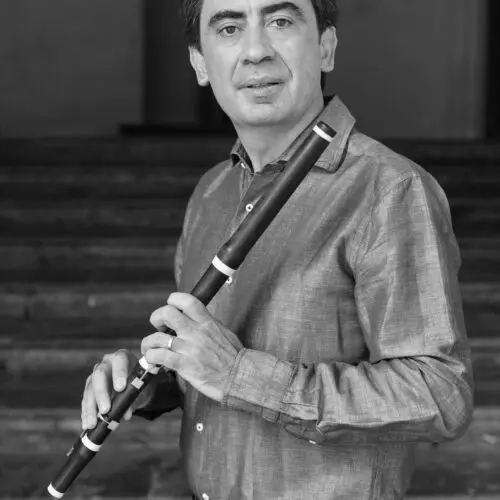
Marcello Gatti
traverso
Marcello Gatti studied music and transverse flute in Perugia (Italy) and early music in Verona. He subsequently studied under Barthold Kuijken at the Royal Conservatory of The Hague (Netherlands), graduating with distinction in 1997.
Particularly praised by critics for his sensitive virtuosity, superb cantabile playing, and stylistic expertise, he performs worldwide on transverse flutes from the Renaissance, Baroque, Classical, and Romantic periods. He has an extensive repertoire, both as a soloist and as a member of chamber and orchestral ensembles that rank among the most renowned and specialized in this field, including Ensemble Aurora, Ensemble Zefiro, Europa Galante, Accademia Bizantina, Le Concerts de Nations, Amsterdam Baroque Orchestra, L’Orfeo Barockorchester, Il Pomo d’Oro, Hofkapelle München, Cantus Cölln, Attaignant Consort, Tafelmusik, Ensemble 1700, Hofkapelle Stuttgart, Salzburger Hofmusik, and many others.
He has participated in more than 80 productions, including audio and video recordings using historical instruments.
Since 1998, he has been passionately dedicated to teaching and has given masterclasses at numerous universities and conservatories. After several years of teaching at the “Felix Mendelssohn” University of Music and Theatre in Leipzig and in Italy, he has been Professor of Historical Transverse Flute at the renowned Mozarteum University Salzburg since 2014. He also teaches at the summer courses of the Accademia Musicale Chigiana in Siena and the Fondazione Italiana Musica Antica in Urbino.
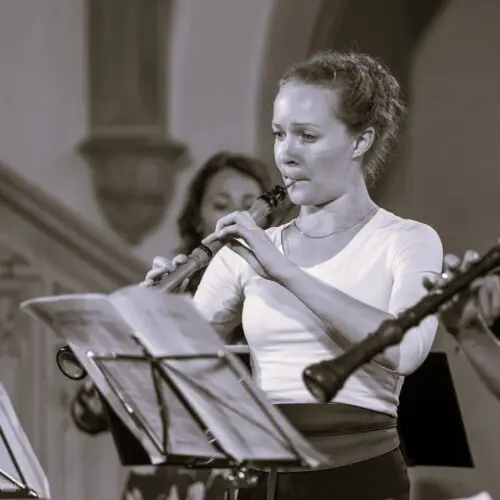
Clara Blessing
oboe
Clara Blessing grew up in a musical environment. Although she had originally signed up for cello lessons at the music school and was on the waiting list, as a child she discovered the recorder—and with it, the world of woodwind instruments. Creating sounds with her own breath and becoming part of the instrument itself—that fascinated her from the very beginning.
The oboe opened the door for Clara to orchestral playing and to the Classical and Romantic symphonic repertoire. Ever since her first captivating experiences in youth orchestras, this repertoire—with the oboe’s distinctive role as part of the ensemble yet frequently emerging in soloistic gestures—has been a matter of great importance to her.
Her enthusiasm for the recorder and the modern oboe led her to explore historical oboes. Immensely supported in this endeavor by her teacher Christian Schneider—who made an instrument from his own collection available to her—Clara began playing the Baroque oboe while still a teenager; she started by teaching herself, then went on to study both modern and historical oboe under Michael Niesemann, ultimately graduating from the Folkwang University of the Arts with a concert diploma awarded with distinction.
She gained particularly valuable insights during her training—as the youngest member of the European Union Baroque Orchestra at the time and as an academy member with the Orchestra of the Age of Enlightenment—as well as through the support she received as a scholarship holder from the German Academic Scholarship Foundation (Studienstiftung des Deutschen Volkes), the German Foundation for Musical Life (Deutsche Stiftung Musikleben), and Yehudi Menuhin’s “Live Music Now.”
She has since established an outstanding reputation as a soloist, chamber musician, and orchestral player. She is the first-choice solo oboist for Concerto Köln and the Köthener BachCollektiv and is a regular guest with renowned ensembles such as the Budapest Festival Orchestra, La Divina Armonia, and Arcangelo. Her concert engagements take her to major festivals and concert halls across Europe, as well as to Asia, Russia, and the USA. Her work is documented in numerous CD, radio, and television recordings. Clara is the first musician in her field to win a prize at the International Telemann Competition in Magdeburg.
Alongside her performing career, Clara devotes herself intensely to a second passion: teaching. Since the 2020 summer semester, she has served as Professor of Historical Double-Reed Instruments at the Würzburg University of Music, and since autumn 2021, she has also overseen the historical oboe program at the Trossingen University of Music. To support her teaching, Clara published *Etüden für Oboe*—a collection of original practice pieces compiled for daily use; released by Edition Walhall in 2021, the volume has since enjoyed great demand.
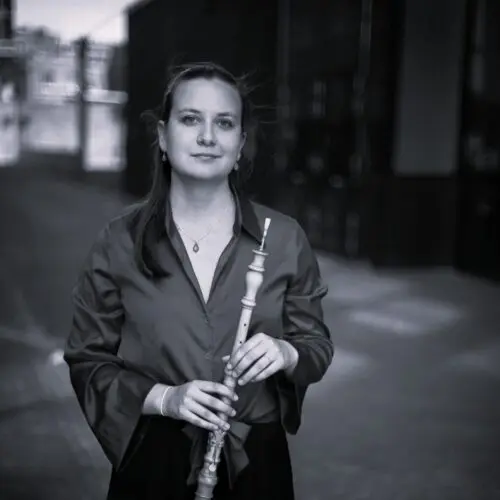
Johanna Boehm
oboe
Johanna Sophia Boehm was born in Washington, D.C., and grew up in Germany.
From 2014 to 2018, she was a member of the Early Music Talent Development Program at the Schola Cantorum Basiliensis and attended several masterclasses with S. Temmingh and A. Dorwarth. From 2018 to 2019, she attended the Schola’s Pre-College Early Music program under the direction of S. Schacht, C. Wiesmann, and K. Bopp. She subsequently completed a bachelor’s degree at the Conservatorium van Amsterdam, studying recorder and baroque oboe with J. Isaac and J. Domenech. In July 2026, she successfully completed her master’s degree in baroque oboe at the Berlin University of the Arts (UdK) with X. Löffler.
In addition, she regularly participates in masterclasses throughout Europe, including with A. Böhlen, A. Bernardini, A. Brüggemann, A. Power, E. Bosgraaf, and A. Torunczyk.
Johanna has won several first prizes at the national level of the Jugend musiziert competition, both as a recorder soloist and as a member of recorder and mixed early-music ensembles. In October 2019, she won first prize and the Youth Jury Prize at the Open Recorder Days Amsterdam with her ensemble Gorgonzola. In 2026, she also won first prize in the Fringe Ensemble category at the Open Recorder Days with her duo Reimagined.
She has performed, among others, with Akademie für Alte Musik Berlin (Akamus) (2025–26), the lautten compagney Berlin (2025–26), the Netherlands Bach Society (2022–24), Vox Luminis (2024), Holland Baroque (2023–24), Royal Wind Music (2023), the Freiburg Baroque Orchestra (2022), the Jerusalem Baroque Orchestra (2022), and the La Cetra Barockorchester Basel (2016).
Sina Bayer
recorder
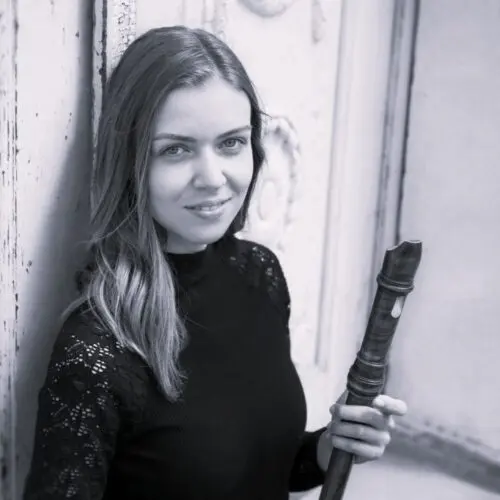
A wide range of musical influences sparked Sina Bayer’s interest in historically informed performance practice, which ultimately led her to the recorder. She began training as a woodwind instrument maker, specializing in recorder making, and successfully completed her training in 2016.
In the same year, she began her studies at the University of Music and Performing Arts Frankfurt, initially with Prof. Michael Schneider and later with Prof. Jan Van Hoecke. During her studies, she was a recipient of the Deutschlandstipendium and worked for several years as a student assistant at the Institute for Historical Performance Practice.
Her experience with the craftsmanship and construction of her instruments complemented her musical studies and accompanied her throughout her time at the University of Music and Performing Arts. Following her bachelor’s degree with an artistic focus, she continued with a master’s degree specializing in “Historical Performance Practice.”
In addition to recorder as her principal instrument, she also took up the study of the transverse flute, initially with Georges Barthel and subsequently with Prof. Daniela Lieb, completing this course of study in 2025.
Sina Bayer explores a wide range of recorders and transverse flutes from the Middle Ages through the Romantic period, as well as the music written for them, and continues to work as a recorder maker. One focus of her artistic work is chamber music and the presentation of Renaissance repertoire through the recorder trio Evviva!, with which she has performed, among other venues, at the Weilburg Palace Concerts and the Innsbruck Festival of Early Music.
Sina Bayer receives further musical inspiration through various masterclasses, including those with Kees Boeke, Walter van Hauwe, and Michala Petri.
Anouk Krüger
recorder
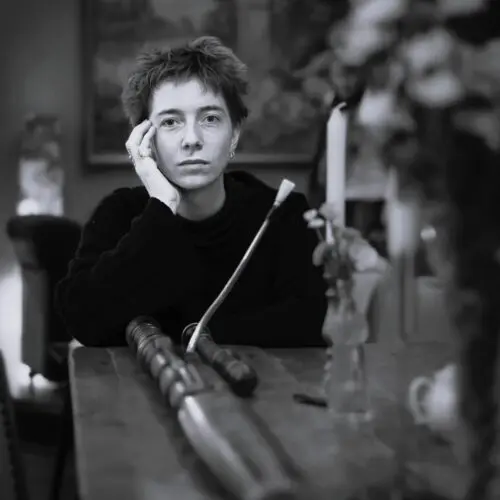
Anouk Krüger completed her bachelor’s degree at the University of Music and Performing Arts Frankfurt (HfMDK), combining pedagogical and artistic training. She subsequently completed her Master of Music at the same institution with Prof. Jan Van Hoecke. She graduated from both final examinations with distinction.
In 2024, alongside her master’s degree in recorder, she began a bachelor’s degree in historical bassoon instruments at the HfMDK with Elena Bianchi. In 2025, however, she transferred to the Leipzig University of Music and Theatre (HMT Leipzig), where she now studies with Györgyi Farkas.
During a one-year Erasmus exchange, she studied at the Conservatoire National Supérieur de Musique et de Danse de Lyon (CNSMD Lyon) in the class of Prof. Pierre Hamon.
Anouk Krüger is a multiple national prizewinner of the Jugend musiziert competition, where she herself has already served several times as a member of the state-level jury. In 2024, she was also a jury member for the D-bü competition in Nuremberg. Since the 2021 academic year, she has been a recipient of the Deutschlandstipendium. She has also received support from the Historical Bassoon Alliance and has been a Live Music Now scholarship recipient since 2024.
She has already gained extensive concert experience both in Germany and abroad and has performed with renowned ensembles such as La Stagione Frankfurt and the Göttingen Baroque Orchestra. As a musician, she has performed both as a soloist and with her ensembles at festivals including the Utrecht Early Music Festival, the Helsinki Early Music Festival, the Beethovenfest Bonn, the International Handel Festival Göttingen, and the Köthen Bach Festival.
Ambroise Dojat
bassoon
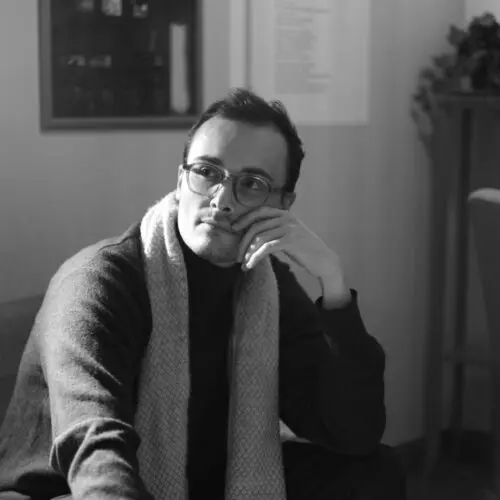
Ambroise Dojat-Gouttard studied bassoon at the Conservatoire National Supérieur de Musique et de Danse de Paris, as well as at the universities of music in Cologne and Mannheim. He subsequently specialized in historically informed performance practice at the Royal Conservatory of Brussels.
During his studies, he was already an academy member of the Royal Stockholm Philharmonic Orchestra and the Freiburg Baroque Orchestra.
Today, he is regularly engaged by renowned European ensembles and orchestras, including the Hamburg State Opera, the Swedish Radio Orchestra in Stockholm, the Copenhagen Chamber Orchestra, Ensemble Pygmalion, the Orchestre des Champs-Élysées, Concerto Köln, and others.
In 2024, he served as principal bassoonist of the Swedish Chamber Orchestra. From 2025 to 2026, he held the position of principal bassoonist with the Royal Danish Orchestra at the Royal Danish Theatre in Copenhagen.
Alongside his musical career, he has a great passion for cooking and painting. In autumn 2026, he will begin a master’s degree in Cultural Management at the Université libre de Bruxelles.